
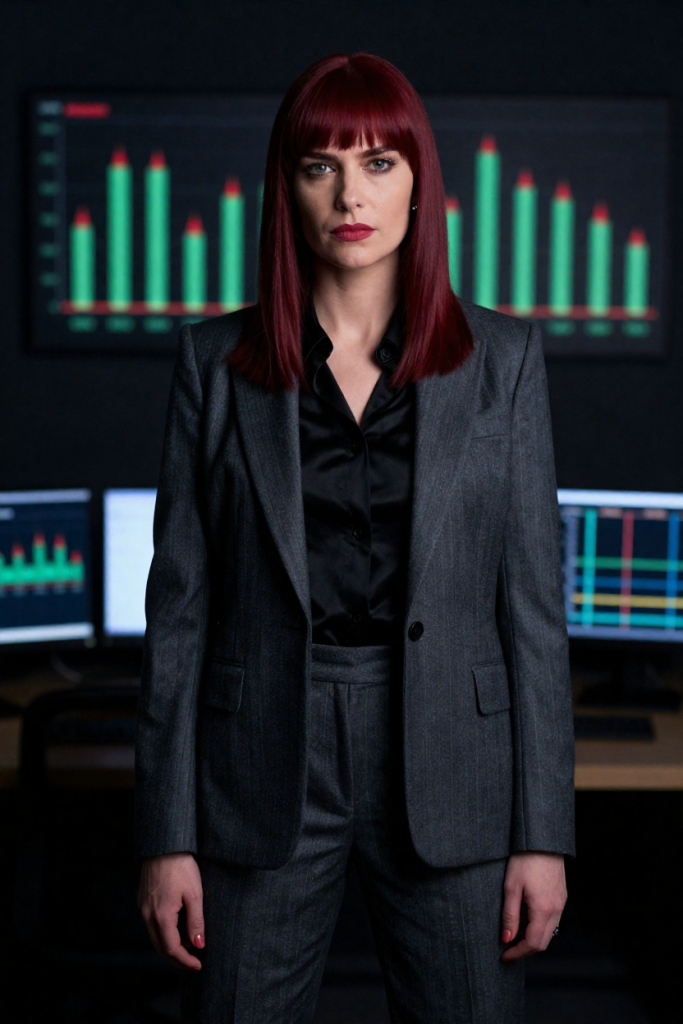
Ask creators why their series drift and most will blame the model. Watch their prompts, though, and the cause is clerical: the character is re-described from memory every session, and memory edits. One week she has “deep wine-red hair,” the next “auburn waves,” and the audience watches a stranger take over the feed. On a desk, this problem has an old solution: a standing instruction, written once, executed verbatim. For a character, that instruction is the brief.
The anatomy of a standing brief
A working brief has five anchors, in this order: age (always stated as a number, 25 or over), hair (colour, length, one default style), build (two or three words, no more), face (one or two durable details — sharp cheekbones, a small stud earring), and a signature (the item that survives cropping and tells a thumbnail apart). Everything else — wardrobe, set, light, pose, mood — is a scene line, and scene lines are supposed to change.
Two rules keep the brief healthy. First, anchors are phrased concretely and positively: “deep wine-red hair worn straight with curtain bangs” survives generation; “beautiful hair” is an opinion the model re-interprets on every print. Second, the brief is versioned. When you deliberately evolve the character — a haircut arc, a new signature — save the new brief as version two and date it, so older sets remain reproducible and the change reads as a decision, not as drift.
Running a series on the brief
Production then becomes mechanical in the best way. Brief a set by pairing the standing brief with three to five scene lines sharing one setting and light setup. Generate wide at the standard model’s 6-credit price, cull to the best third, and only then spend on edits, swaps and upscales. When a frame comes back off-character, the diagnosis is fast: either a scene line contradicted an anchor (a “short bob” scene line fighting the brief’s curtain bangs) or an anchor itself is too vague to hold.
What the brief cannot do
It cannot rescue a character who was never visually decided. If your anchors are adjectives — gorgeous, stunning, perfect — no filing system will hold her. Decide the woman on paper first. The brief is not where creativity happens; it is where creativity is kept, so the chart of her output reads as one line instead of noise.